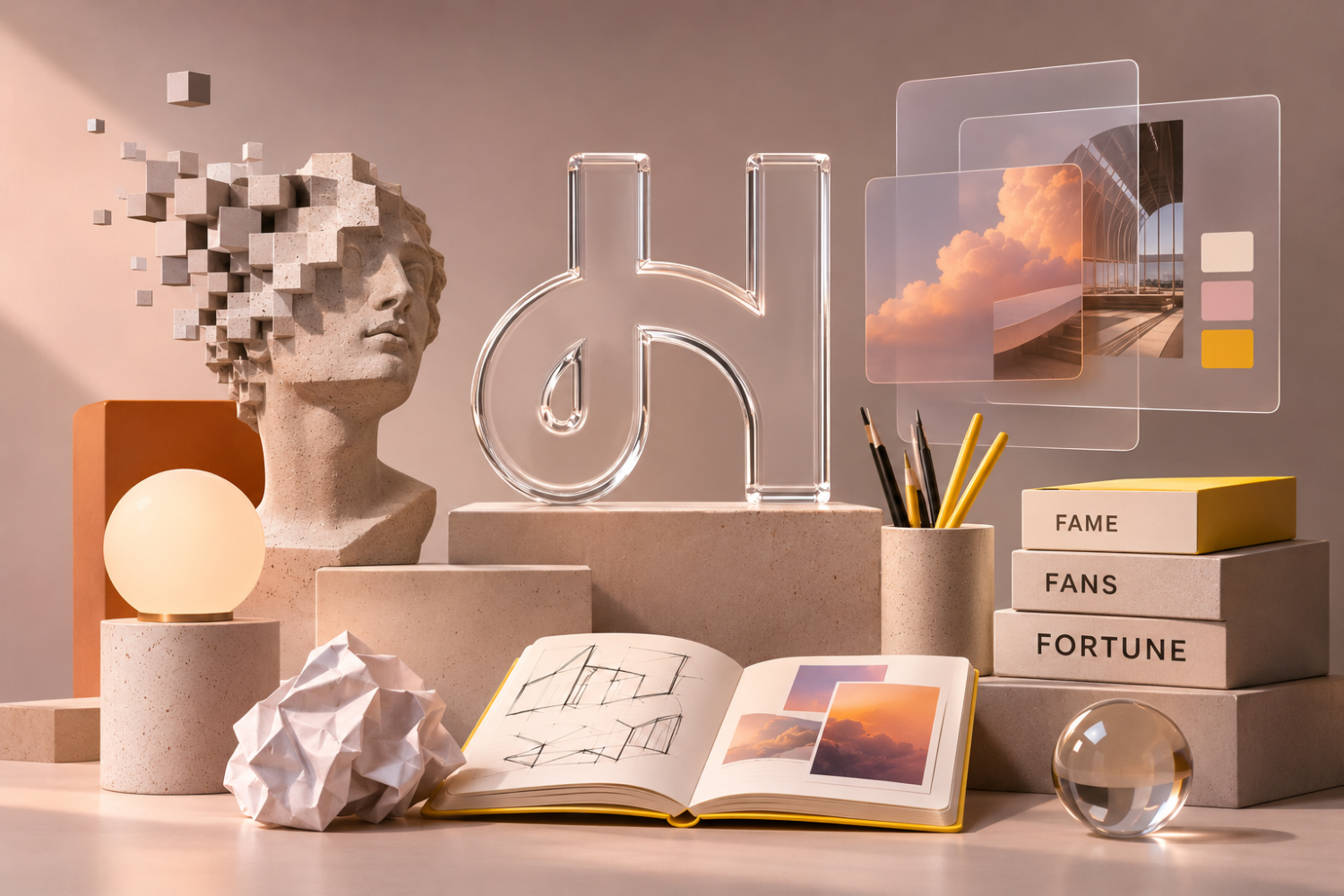
AI has given the creative industry extraordinary new possibilities. So why are we producing more of the same? Kate Walmsley argues that the real threat to creativity isn’t artificial intelligence, but our failure to be imaginative enough with it.
There is something faintly absurd about the current state of AI and creativity. We’ve been handed technology that can conjure almost anything we can imagine — from the minutest details of an experience to an entire world — and what are we doing with it? Producing more of the same. More iterations and variations on familiar themes, in an inexhaustible supply that may look impressive but doesn’t feel memorable.
The backlash against ‘AI slop’ is understandable. There’s a particular kind of creative emptiness to work that has all the surface qualities of something interesting but none of the substance. Yet I find the conversation around it slightly misplaced — we talk about AI as though it’s responsible for the mediocrity, when perhaps it’s simply making that mediocrity easier to produce. If anything, the technology is exposing the limits of our imagination, not imposing them.
And I find that a more useful approach, because for all the anxiety about what AI might take away from creative industries, I’m far more interested in what it can give us.
How AI can support the creative process
I remember an art teacher who would make children crumple up a piece of paper before they started drawing. It was a wonderfully simple way of removing the intimidation of a blank page. Once the paper was creased and imperfect, there was no longer anything precious about making that first mark. You could just get started, responding to the shapes and possibilities already in front of you.
That’s how I like to think about AI in the creative process. Anyone who has worked in a creative studio knows how much time can disappear between the first conversation about a brief and the moment something genuinely interesting starts to emerge. There are references to gather, territories to explore, half-formed thoughts to articulate and ideas that need to be rendered tangible before anyone can properly respond to them. AI allows us to get out of the blocks faster, filling that intimidating white space with stimulus and possibility.
Most of what it produces won’t be bang on, of course, but that’s hardly unique to AI. The creative process has always involved pursuing ideas that go nowhere, making connections that don’t quite work and discovering, often by accident, the small kernel of something worth developing. The difference now is the speed with which we can reach that point. And when time is at such a premium, finding the golden nugget earlier means having more time to do the work that really matters: interrogating the idea, bringing other perspectives into it, testing its limits and giving it the depth and originality it deserves.
At Household, we’re embracing these tools precisely because they create more room for that kind of thinking. They allow us to explore ideas more expansively and make unexpected possibilities visible much earlier in the process. And what interests me most isn’t the efficiency — it’s what happens when creative people are given more time and space to be curious.
I’ve always believed that the most exciting ideas tend to emerge at the intersection of seemingly unrelated things. Creativity is an act of curiosity as much as imagination: noticing a behaviour in one context that might transform another, borrowing a principle from an entirely different discipline, or recognising an emotional truth that nobody has yet found a way to express. Working across retail, hospitality and entertainment has taught us that the boundaries between categories are often far less interesting than the possibilities that can exist between them. A new way of thinking about hospitality might unlock an entirely different approach to retail. An idea borrowed from entertainment might transform how people experience a place.
AI makes it easier to pursue those threads, however unlikely they may seem at first. We can visualise the improbable, experiment with the unfamiliar and explore creative territories that may previously have been dismissed as too difficult or time-consuming to investigate. Surely that should make us more ambitious about what we ultimately bring into the world, as the barriers to imagining something extraordinary fall away?
Did AI make this?
Which brings me to the question that seems to hang over almost every piece of creative work now: did AI make this?
I’m not convinced it’s a particularly useful question. I’m much more interested in whether there’s an original thought behind the work, whether it responds intelligently to the challenge at hand and whether it offers people something they haven’t experienced before. Can it take a brand’s promise and turn it into something tangible? Can it change how someone feels, behaves or thinks? Those seem to me far more meaningful measures of creativity than the tools involved in its production.
At Household, we talk about fame, fans and fortune as a measure of what great creativity should achieve. Fame is about earning a place in the conversation, creating something distinctive enough to capture attention in a world already overflowing with things to look at. Fans emerge when that attention becomes genuine affection, when an experience resonates so strongly that people want to participate, share it and return. And fortune is the commercial value that follows when those connections translate into meaningful results for a brand.
It’s a useful discipline, particularly now. AI has made it extraordinarily easy to create things that look impressive, but looking impressive doesn’t necessarily make something famous, and attracting attention doesn’t guarantee you’ll earn a fan. The challenge is to create work that achieves all three, combining originality and emotional resonance with commercial purpose. That’s a far more interesting ambition than simply producing something nobody has seen before.
Why creative ambition still needs human judgement
Of course, being able to generate an idea and knowing what to do with it are very different things. There’s a particular combination of experience, instinct and conviction involved in recognising potential, especially when an idea doesn’t resemble anything that’s come before. It takes courage to back something unfamiliar, intelligence to understand why it might resonate and the willingness to keep questioning and refining it long after the first exciting visual has appeared on the screen. AI can give us an extraordinary breadth of possibilities, but it can’t make those creative decisions on our behalf.
Household was recently named Independent Agency of the Year at the Creativepool Annual 2026, an achievement I’m enormously proud of. It has also made me reflect on what independence means at a moment when the creative industry is undergoing such profound change. For me, it’s the freedom to follow our curiosity and the conviction to pursue ideas that don’t yet have a blueprint. It’s being able to challenge the expected answer, take an unfamiliar route and invest in a creative possibility because we believe it could become something extraordinary.
I see AI as an opportunity to do more of that. Not simply to work faster, although that’s certainly welcome, but to think more expansively, experiment more freely and make braver creative decisions. It should encourage us to ask more ambitious questions of ourselves and of the work we put into the world.
What worries me isn’t the prospect of machines becoming more imaginative than people. It’s the possibility that we’ll become so enamoured with what they can produce that we’ll stop demanding more of our own imaginations. That we’ll confuse an abundance of ideas with genuine originality, or mistake the ability to visualise something for the achievement of creating something worth experiencing.
We have an extraordinary opportunity to make things that might once have existed only in the wildest corners of our imaginations. I’d hate for us to look back on this moment and discover that, given the freedom to imagine almost anything, we mostly chose to make more of the same.
The limits of what we can create are changing. Our ambitions ought to change with them.
About the author
Kate Walmsley is Executive Creative Director at Household, leading creative across brand, space, digital and service to create experiences that turn customers into fans. Previously a Creative Director at WPP and a senior creative lead at Imagination, she was named one of Creativepool’s Top 100 Creative Leaders in 2026.
